Samsung Washer Error Code 4C: Meaning, Causes, and Easy Fixes
Samsung washer error code 4C means a water supply problem. Learn what causes it, what to check yourself, and when the washer needs service.
ERROR CODES
1/19/20268 min read

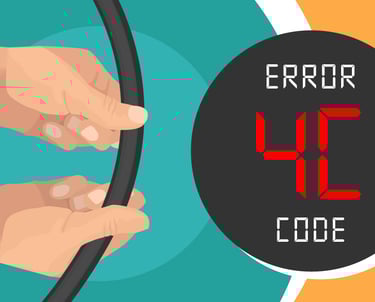
What 4C Means on a Samsung Washer
Your washer needs to fill with water before it can continue with certain parts of the wash cycle.
When the machine detects that water isn't entering as expected, it can stop the cycle and display 4C.
The code doesn't tell you that a particular component has failed. It tells you that the washer has detected a water-filling problem.
That distinction is important.
For example, if the water tap behind the washer is closed, the washer may display the same type of error as it would if an internal water-inlet component had failed.
So don't start by buying a replacement valve. Start by following the water's path into the machine.
Water tap → inlet hose → mesh filter → water inlet system → washer drum
The problem can occur anywhere along that route.
The First Things to Check
Before taking anything apart, check these four things:
Are both water supply taps fully open?
Are the inlet hoses kinked or crushed?
Is there good water pressure?
Are the small inlet screens clogged with debris?
If you find an obvious problem with one of these, correct it and run the washer again.
If everything looks normal, continue with the more detailed checks below.
1. Make Sure the Water Supply Is Actually On
This sounds obvious, but it is one of the first things worth checking.
Look behind the washer and find the water supply valves connected to the inlet hoses. Make sure they are fully open.
A valve that is only partially open can restrict the amount of water reaching the machine.
This is particularly easy to overlook if someone recently:
Cleaned behind the washer
Moved the appliance
Turned the water off for plumbing work
Replaced an inlet hose
Installed the washer in a new location
Samsung recommends checking that the water taps are fully open when troubleshooting 4C/4E.
What happens next?
If a valve was closed, open it fully and try the washer.
If the washer fills normally, you have probably found the cause.
If the valves were already open, don't keep restarting the washer. Move on to the hoses.
2. Look for a Kinked Inlet Hose
The hoses behind a washing machine can easily become squeezed when the appliance is pushed back against the wall.
A hose doesn't have to be completely crushed to cause a problem. Even a significant restriction can reduce water flow enough for the washer to complain about filling.
Pull the washer forward enough to inspect the hoses safely.
Look for:
Sharp bends
Flattened sections
Hoses trapped against the wall
Damaged or deteriorated hose sections
If a hose is simply bent, reposition it so that water can flow freely.
If the hose is damaged, replacing it is preferable to trying to patch it.
A useful clue
If the washer worked perfectly before it was moved and 4C appeared afterward, the hoses deserve extra attention.
A newly installed or recently moved washer is much more likely to have a connection or hose-positioning problem than one that has been sitting untouched for years.
3. Check Whether Your Home Has Enough Water Pressure
If the valves are open and the hoses aren't kinked, the next question is:
Is enough water actually reaching the washer?
Open a nearby faucet and check the water flow.
If the pressure is weak throughout the house, the washer may not be the problem.
You may have:
A temporary water-supply issue
A partially closed household valve
Low pressure from the building's plumbing
A plumbing restriction
Samsung identifies insufficient water pressure or flow as one possible cause of 4C/4E. Some Samsung documentation gives a pressure range for applicable models, but the exact requirement can vary, so use your washer's manual for the definitive specification.
Here's the useful diagnostic distinction:
Weak water everywhere: investigate the household supply.
Strong water elsewhere but weak flow into the washer: investigate the washer's hoses, filters and inlet system.
4. Check the Small Mesh Filters
This is one of the most useful checks because a tiny amount of debris can restrict water flow.
At the points where the inlet hoses connect to the washer, there may be small mesh screens designed to prevent sediment from entering the machine.
Over time, they can collect:
Sand
Rust particles
Mineral deposits
Other debris from the water supply
Samsung recommends checking and cleaning these filters when dealing with water-supply errors.
Before checking them
Turn off the water supply.
If you need to disconnect an inlet hose, follow the instructions for your particular model and be prepared for some residual water.
Do not force a filter out if your model doesn't provide a clear removal procedure.
What you're looking for
A clean screen should allow water to pass through without significant restriction.
If the screen is covered with sediment, carefully clean it according to Samsung's instructions for your model.
Reconnect everything securely and turn the water supply back on.
Check carefully for leaks before running the washer.
Samsung recommends regular cleaning of inlet mesh filters on applicable models.
5. Check the Hot and Cold Hoses
If your Samsung washer uses separate hot and cold water connections, make sure the hoses are connected to the correct inlets.
This is especially important if:
The washer was recently installed
You disconnected the hoses
You moved the washer
Someone recently worked on the plumbing
A hose connected to the wrong inlet can create water-supply problems on cycles that require a particular temperature.
Samsung specifically recommends checking the hot and cold connections when troubleshooting applicable water-supply errors.
If the connections are correct and the water supply is good, move on.
6. Don't Forget the Drain Hose
This sounds unrelated to a water-fill error, but it can matter.
The washer needs the drain hose installed correctly. If it is positioned incorrectly, water can leave the machine when it shouldn't.
That can make it appear as though the washer isn't filling properly.
This is worth checking if the 4C error appeared after the washer was installed or moved.
Look at the drain hose and compare its position with the installation instructions for your exact Samsung model.
Don't use a generic measurement from another washer. Drain-hose requirements can vary between models.
7. Reset the Washer After Fixing the Water Supply
Once you've corrected an obvious water-supply problem, reset the machine.
Samsung's troubleshooting guidance for applicable 4C/4E errors recommends disconnecting the washer from power for about one minute before trying again.
The important point is that resetting should come after checking the actual cause.
If a hose is kinked, resetting the electronics won't straighten it.
If a filter is clogged, resetting the washer won't clean it.
A reset can clear the error after the underlying problem has been corrected, but it isn't a substitute for fixing the water supply.
What If 4C Keeps Coming Back?
This is where the diagnosis changes.
If you've confirmed that:
The water taps are fully open
The hoses aren't kinked
Water pressure is adequate
The inlet filters are clean
The hoses are connected correctly
The drain hose is positioned properly
and the washer still displays 4C, the problem may be inside the machine.
Possible causes can include a problem with the water inlet system, wiring, sensors or electronic controls.
At this point, replacing parts based only on the error code isn't a good idea.
A technician can determine whether the washer is actually receiving the expected water flow and whether the internal components are operating correctly.
Can a Dirty Inlet Filter Really Cause 4C?
Yes.
The filter doesn't have to be completely blocked.
Imagine that water normally enters through an unobstructed screen. If mineral deposits and sediment cover much of that screen, the amount of water reaching the washer can fall significantly.
The washer doesn't know that the filter is dirty.
It simply knows that it isn't getting the water it expects.
That's why a clogged inlet screen can produce a water-supply error even though your household water pressure appears normal.
Do You Need to Replace the Water Inlet Valve?
Not necessarily.
This is one of the biggest mistakes people make when troubleshooting appliance error codes.
A 4C code does not automatically mean:
"The inlet valve is bad."
It means:
"The washer isn't getting water as expected."
Those are two very different statements.
A closed valve, kinked hose or dirty filter can produce the same symptom.
Only after those simpler possibilities have been eliminated should an internal component become the focus.
When You Should Stop Troubleshooting Yourself
Basic water-supply checks are reasonable for most homeowners.
Internal electrical diagnosis is different.
Arrange professional service if:
4C keeps returning after the basic checks
The washer has good water pressure but won't fill
You suspect an internal inlet-valve problem
There is a leak from an internal component
Wiring or electrical components need testing
You would need to remove internal panels
The washer displays additional error codes
You are uncomfortable disconnecting water hoses or accessing the inlet connections
Never work on energized electrical components.
If the washer requires internal electrical testing, disconnecting and testing those components should be left to someone qualified to do it safely.
A Simple 4C Troubleshooting Order
If you want the shortest possible diagnostic path, use this order:
1. Water taps
Make sure they are fully open.
2. Inlet hoses
Look for kinks, crushing or damage.
3. Water pressure
Check whether the home's water supply is normal.
4. Inlet mesh filters
Look for sediment and buildup.
5. Hot/cold connections
Make sure the hoses are connected correctly.
6. Drain hose
Check the installation if the washer was recently moved or installed.
7. Reset
Disconnect power according to Samsung's instructions and try the washer again.
8. Professional diagnosis
If 4C returns despite good water supply and correct installation, investigate the washer's internal components.
This order saves time because it starts with the things that are easiest to check and least expensive to fix.
Common Mistakes When Dealing With 4C
Replacing parts too early
Don't buy an inlet valve before checking the water supply.
Ignoring the hoses
A washer can have excellent household water pressure and still have poor water flow because of a kinked inlet hose.
Forgetting the filters
The inlet screens are small and easy to overlook, but they can become heavily restricted.
Assuming 4C always means the same thing on every model
Samsung uses different information codes across different washer models and markets. Always check the manual for your exact model.
Repeatedly resetting the washer
A reset can clear an electronic condition. It cannot repair a physical restriction.
Disconnecting hoses without turning off the water
Always shut off the supply before disconnecting a water inlet hose.
How to Prevent 4C Problems
You don't need an elaborate maintenance routine.
A few simple habits help.
Keep the inlet hoses in good condition.
Make sure they aren't crushed when the washer is pushed back.
Don't ignore sediment.
If your water supply contains noticeable sediment, periodically inspect the inlet screens according to your model's maintenance instructions.
Check connections after moving the washer.
A washer that has been pulled forward for cleaning should be checked before being pushed completely back.
Pay attention to changes in water pressure.
If other faucets suddenly have weak flow, investigate the household supply before blaming the washer.
Replace damaged hoses.
A hose showing obvious deterioration is worth replacing rather than waiting for a leak.
Frequently Asked Questions
Is 4C the same as 4E on a Samsung washer?
On many Samsung washers, 4C and 4E indicate the same general water-supply or filling problem. Samsung also uses variations of these codes on some models. Always confirm the code against your specific model's manual.
Can I fix Samsung 4C myself?
Often, yes. Checking the water valves, inlet hoses, water pressure and accessible inlet filters are reasonable homeowner checks. If those are all fine and 4C continues, the problem may require professional diagnosis.
Why does my Samsung washer say 4C when the water is turned on?
A turned-on water supply doesn't guarantee sufficient flow. The hose may be kinked, the inlet filter may be clogged, water pressure may be low, or the washer may have an internal water-inlet problem.
Can a clogged filter cause Samsung 4C?
Yes. Sediment and mineral buildup on the inlet mesh filter can restrict water flow enough to prevent the washer from filling normally.
Does 4C mean my Samsung washer needs a new valve?
No. The error indicates a filling problem, not a confirmed failed valve. Check the external water supply first.
How do I reset a Samsung washer showing 4C?
After addressing the water-supply problem, Samsung recommends disconnecting power for about one minute on applicable models before restoring power and trying the washer again.
Is it safe to keep using the washer with 4C?
If the washer cannot fill normally, it's better to resolve the problem before continuing to run cycles. Repeatedly restarting a machine that cannot establish its water supply won't fix the underlying cause.
Read More:
KitchenAid dishwasher error code F6E1 - Troubleshooting Guide
Whirlpool washer error code F21: Meaning, Causes, and Easy Fixes